The dominant primordial beast
The Call of the WildThe dominant primordial beast is the novel’s governing image for the ancient nature that awakens in Buck under the violence and freedom of the North. It explains how a dog taken from the civilized world becomes an intelligent, formidable creature shaped by the Law of Club and Fang, yet remains capable of profound love for John Thornton until that bond is finally broken. The expression therefore names both Buck’s regression from domestic life and his recovery of an older, more authentic identity.
Awakening Under Trail Conditions
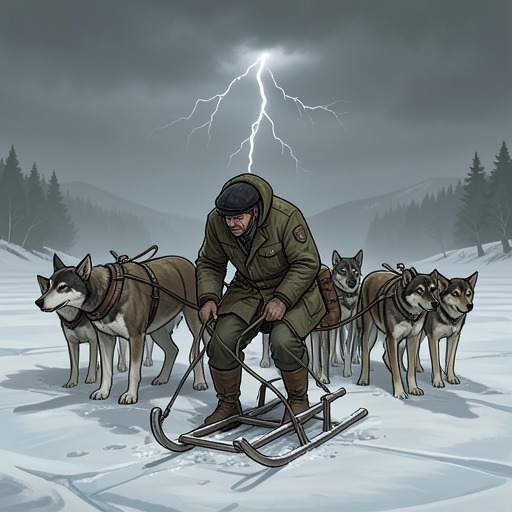
The process begins in a world where men and dogs are described as savages obeying no law except the Law of Club and Fang. Buck’s first decisive lesson comes through Curly’s death. After a husky tears her face open and knocks her down, thirty or forty dogs silently surround the combatants, waiting for the fall that will allow them to attack. When Curly is buried beneath the bristling mass, Buck understands that there will be no fair fight: once an opponent goes down, the struggle is over. The scene becomes a permanent warning, returning to trouble him in sleep, and it produces his bitter, deathless hatred of Spitz, whose laughter shows that the leader understands this order completely. The harness then converts Buck’s understanding into practice. Francois fastens straps and buckles on him and sets him to haul a sled and firewood, while Dave corrects errors by nipping his hindquarters and Spitz enforces the team’s hierarchy with growls. Buck’s dignity is wounded, but he does not rebel; he applies himself and learns the practical discipline of work. In this environment, survival depends less on the habits of the home than on alertness, obedience, endurance, and the ability to read danger.
Body, Instinct, and Ancestral Memory
Buck’s change is physical as well as psychological. His muscles become hard as iron, ordinary pain loses its power over him, and his body extracts nourishment from food that would once have seemed loathsome or indigestible. His sight and scent sharpen, his hearing becomes acute enough to distinguish peace from peril while he sleeps, and he learns to bite ice from between his toes and break the crust over a water hole with his forelegs. He can even scent the coming wind a night in advance and place his nest where it will later leave him sheltered. Experience alone does not account for this development. As the domesticated generations fall away, instincts that had long been dormant return to life. Buck remembers, in vague but powerful ways, the youth of his breed, when wild dogs ran in packs through primeval forests and killed their meat while pursuing it. The cut, slash, and quick wolf snap come to him without conscious discovery, as though inherited knowledge had been waiting beneath civilization. When he howls at a star on still, cold nights, the sound joins him to dead ancestors whose lives have become the emotional and bodily substance of his own. The narrative links this awakening to the economic accident that brought him north. Manuel, a gardener’s helper whose wages could not cover the needs of his family, helped set in motion the chain that carried Buck away from the Santa Clara Valley. Human poverty and the search for northern gold thus become the conditions through which an older animal nature resurfaces. The primordial beast is not presented as an arbitrary possession; it is released by circumstance, labor, hunger, climate, and violence.
Cunning, Rivalry, and Mastership
The beast’s growth remains secret at first. Buck’s new cunning gives him poise and control rather than rashness. He avoids unnecessary fights and shows no impatience in his hatred of Spitz, while Spitz repeatedly displays his teeth and tries to provoke the struggle that can end only with one dog’s death. Buck’s restraint is therefore tactical, not merciful: he is adjusting himself to the new life and waiting for the conditions in which force and judgment can work together. His covert resistance begins when he interferes with Spitz’s discipline. After Pike hides beneath a foot of snow, Buck places himself between the unearthed dog and the furious leader, hurling Spitz backward and allowing Pike to recover enough courage to spring upon him. Francois beats Buck with the butt and lash of the whip, but the punishment cannot drive him away from his rival. Thereafter Buck continues to obstruct Spitz when Francois is absent, and his mutiny spreads general insubordination through the team. The disruption is not random rebellion: it is the first visible challenge to Spitz’s authority and the beginning of Buck’s claim to mastership. When the final fight comes, Buck combines instinct with imagination. Surrounded by a silent circle of sixty dogs waiting to finish whoever falls, he does not merely repeat a familiar shoulder trick. He feints, sweeps low, and breaks Spitz’s left foreleg; then he repeats the maneuver and breaks the right. Spitz struggles on three legs while seeing the same circle that had once closed around defeated enemies now closing around him. Buck refuses to yield the advantage. In the final rush he meets Spitz shoulder to shoulder, and Spitz disappears into the dark mass of waiting dogs. Buck remains standing as the successful champion, the dominant primordial beast who has made his kill. Leadership immediately reveals that the expression means more than physical ferocity. Buck takes up the head of the team and proves superior even to the experienced Spitz wherever judgment, quick thought, and decisive action are required. He also restores order. He repeatedly shakes Pike for loafing until Pike pulls harder than ever, subdues Joe when Joe snaps, and brings the unruly team back to its former solidarity. At the Rink Rapids, he breaks in Teek and Koona with such speed that Francois is astonished. His authority is functional as well as coercive: the team once again leaps as one dog in the traces.
The Beast Against Human Misjudgment
The expression also exposes the difference between authentic mastery and the crude authority of men who misunderstand the North. After Buck and his companions have covered twelve hundred miles with only two days’ rest, the exhausted team is sold to Hal and Charles. Their camp is disorderly, their knowledge inadequate, and Hal’s confidence is advertised by a revolver, hunting knife, and belt bristling with cartridges. Mercedes, Charles’s wife and Hal’s sister, protests against harsh treatment, but Hal insists that dogs are lazy and must be whipped. The evidence instead shows that they are weak from exhaustion and need rest. Mercedes adds one hundred and twenty pounds to the load by riding in the sled for days, while Charles and Hal quarrel, leave the fire unbuilt, and fail to feed the dogs. When the food runs out at the Five Fingers, they trade for frozen horsehide, which turns into indigestible hair and leathery strings in the dogs’ stomachs. Hal’s theory that suffering produces hardness becomes literal violence: failing to impose it through argument, he hammers it into the dogs with a club. The contrast is decisive. Buck’s harshness arose from accurately reading the conditions of survival and organizing a team; Hal mistakes cruelty for knowledge and weakness for disobedience. John Thornton recognizes what Hal cannot. He warns that the ice below White River is rotten and may collapse at any moment, insisting that only fools, aided by blind luck, would risk it for gold. Hal answers with contempt and prepares to continue toward Dawson. When Buck refuses to rise, Hal beats him, but Thornton cuts the traces and removes him from the beating. Buck is too weak even to wag his tail, yet the rescue preserves the life that Hal’s theory would have spent without understanding. The primordial beast also operates as protective force within human society. At Circle City, Black Burton strikes Thornton, and Buck responds with a roar rather than a bark, leaping for the attacker’s throat. He tears open Burton’s throat before the crowd drags him away. A miners’ meeting decides that Buck had sufficient provocation and discharges him, but his reputation is made. The same capacity that destroys rivals in the dog world becomes loyalty and defense in relation to Thornton.
Love, the Wild Call, and the Final Form
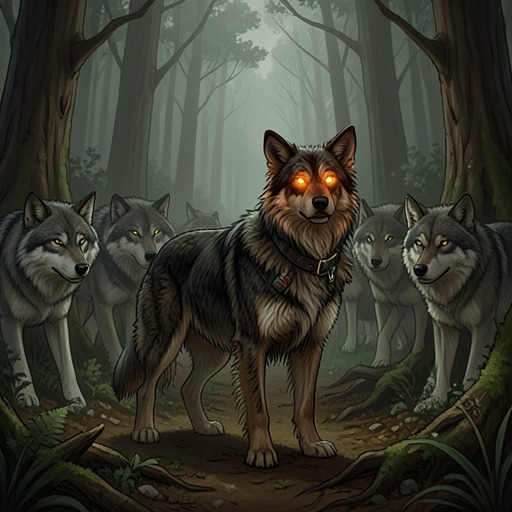
Buck’s return to primordial life does not erase his bond with John Thornton. The narrator places him beside Thornton’s fire as a broad-breasted, white-fanged, long-furred dog while the shades of half-wild and wild ancestors surround his present existence. They taste the meat he eats, scent the wind with him, listen to the forest with him, and direct his moods and actions. As these ancestral presences beckon more insistently, mankind and human claims recede, but Thornton’s love repeatedly draws Buck back from the forest to the fire. The tension becomes bodily and active. Buck sleeps at camp for two days after Thornton’s death, follows him constantly, watches him eat, and sees him into and out of his blankets. Then the forest call grows stronger. Buck wanders for days, crosses the divide, searches for the wild brother, kills a black bear while fishing for salmon, and later scatters a dozen wolverines fighting over the carcass. These acts awaken the last latent remnants of his ferocity. He becomes a self-sufficient killer, surviving by his own strength in an environment where only the strong endure, and pride enters his movements, muscles, coat, and bearing. At this height, Buck’s mixed inheritance becomes visible in his form and behavior. His size and weight come from his St. Bernard father, while his shape comes from his shepherd mother; his muzzle and head resemble those of a wolf on a massive scale. His cunning is both wolfish and wild, while his intelligence joins shepherd and St. Bernard traits to the experience gained in the fiercest school. He responds to sight, sound, and danger with such speed that perceiving, deciding, and acting seem simultaneous, and his vitality appears ready to burst outward in sheer ecstatic force. The final release occurs after the Yeehats kill John Thornton. With the last human tie broken, Buck hears the wolf pack’s call more compellingly than ever and stands in the moonlit clearing awaiting its arrival. He kills the first wolf that charges, drives back three others, and holds the pack at bay for half an hour from an angle protected on three sides by a gravel bank. When the wild brother approaches, the two touch noses; an old wolf begins the long howl, the pack joins, and Buck answers. He then leaves the angle and runs into the woods beside the wild brother. The later legend completes the meaning of the expression. The Yeehats observe changes in the timber-wolf breed, including brown markings on head and muzzle and a white rift down the chest, and they tell of a Ghost Dog leading the pack. This creature steals from camps, robs traps, kills dogs, defies hunters, and leaves victims with throats slashed and enormous wolf prints in the snow. The dominant primordial beast has therefore moved from hidden inheritance, to bodily adaptation, to individual mastery, and finally to a new collective identity in the wolf pack. Buck’s ending is neither simple animal degradation nor simple triumph: it is the complete severing of civilization, followed by a legendary existence in which his intelligence and violence become the defining power of the wild.